
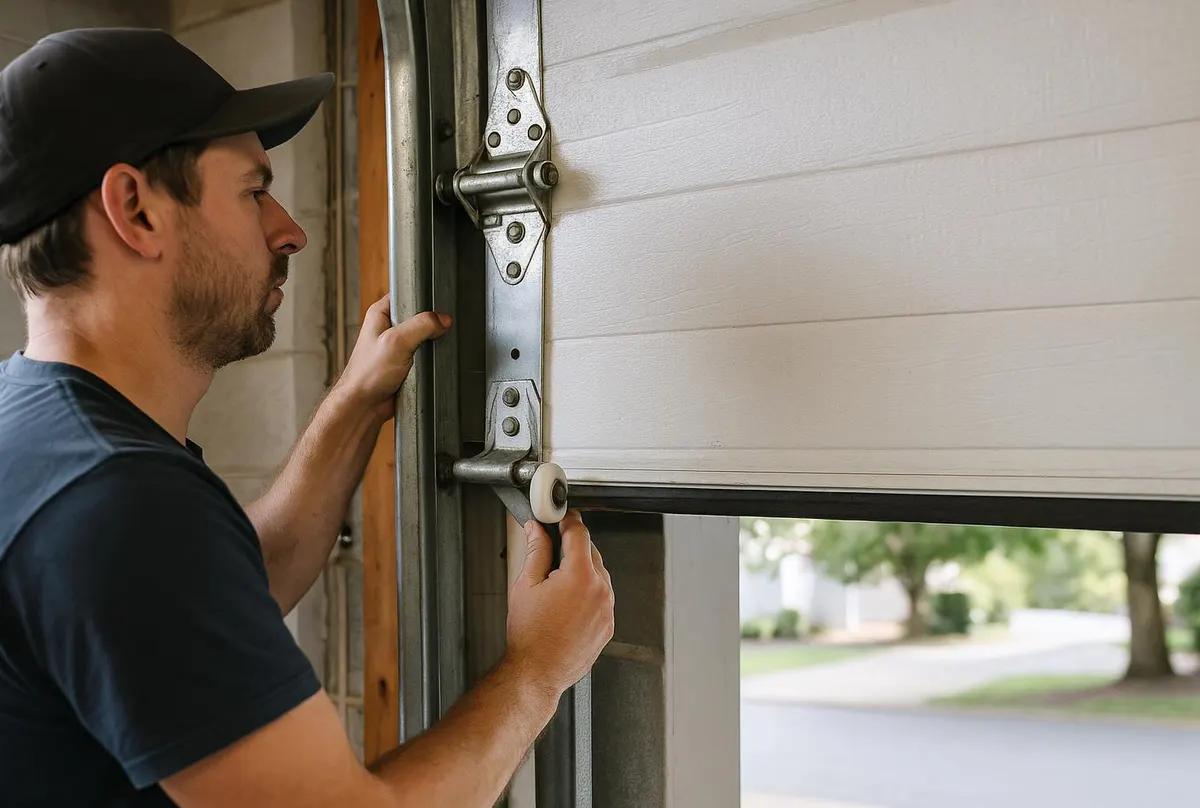
The first thing most people do when a garage door won't budge on a cold morning is push harder, hit the wall button over and over, or try to pry the bottom edge loose by hand. It's an understandable reaction — you're already running late, the door looks stuck for no obvious reason, and giving it one more good shove feels faster than troubleshooting. But a door that's resisting for a real mechanical reason doesn't need more force, it needs less. Forcing a stuck door is how a bent track, a stripped opener gear, or a snapped cable turns a five-minute inconvenience into a repair bill.
What a Cold-Weather Sticking Door Looks Like
Lake County doesn't get hard freezes often, but a few cold snaps roll through most winters, and the combination of overnight chill with our usual humidity is enough to cause real symptoms. Before troubleshooting, it helps to know what you're actually seeing:
- The door moves noticeably slower than usual, especially in the first foot of travel
- The opener strains, groans, or reverses partway through the cycle
- The bottom seal looks like it's gripping the concrete slab instead of resting on it
- There's a grinding or squealing sound from the rollers or tracks
- The door stops and won't restart until you manually push or pull it
- Frost or a thin film of moisture is visible on the tracks or weatherstripping
Any one of these on its own might be minor. Several together usually point to one of the causes below.
What's Actually Going On, in the Order a Technician Checks It
1. The Bottom Seal Is Stuck to the Slab
This is the most common culprit and the one people mistake for the door being "frozen" even when it's nowhere near freezing outside. Humidity collects under the door overnight, and on a cold morning that moisture can make the rubber weatherstripping cling to the concrete almost like a weak adhesive. The fix is simple: a technician breaks the seal gently by hand along the full width of the door before ever running the opener, then checks whether the seal has hardened or cracked from age and UV exposure. A brittle seal that's lost its flexibility gets replaced — a soft, pliable seal won't grip the slab the same way.
2. Debris, Rust, or Ice in the Tracks
Next comes a visual check of both tracks for anything blocking smooth roller movement. In this climate that's usually rust from humidity rather than ice, but on the rare hard-freeze night, condensation inside the track can actually crystallize and jam a roller. Either way, the fix involves cleaning the track with a dry cloth, removing rust with a wire brush where it's starting to flake, and confirming the track is still straight. A track that's been bent even slightly from a prior forced attempt won't let the rollers glide no matter how clean it is.
3. Thickened Lubricant and Stiff Hardware
Cold makes standard grease and old lubricant thicken, and rollers, hinges, and the torsion spring itself all move a little stiffer as a result. This matters more here than in a drier climate because humidity has usually already started some corrosion on hardware that wasn't lubricated recently. A technician checks each roller and hinge by hand for resistance, then applies a silicone-based garage door lubricant — never household oil or WD-40, which attracts dust and grime and gums things up worse over time.
4. Spring Tension
Metal contracts slightly in cooler temperatures, and torsion springs can lose a small amount of effective tension on a cold morning. This shows up as a door that feels heavier than normal when lifted manually, or an opener that strains on the first cycle of the day and runs normally once things warm up. Checking spring tension is not a homeowner task — these springs are under serious load and adjusting them requires the right tools and experience. If a spring is already weakened from age or corrosion, a cold snap is often what pushes it the rest of the way to failure.
5. Opener Force and Limit Settings
Modern openers have a built-in safety feature that reverses the door if it senses more resistance than expected — which is exactly what happens when rollers are stiff or a spring is under-tensioned. If everything mechanical checks out but the door still won't complete a full cycle, the force and limit settings get tested and recalibrated. Resetting these without first fixing the mechanical cause just hides the problem until it reappears.
6. Panel Swelling
Wood and composite panel doors absorb humidity over our long wet months, and a sudden cold, dry snap can cause them to contract unevenly, leaving a slightly warped or tight-fitting panel that rubs against the frame. This is checked last because it's less common than the issues above, but it's worth ruling out on older wood-composite doors, especially ones that haven't had a tune-up in a while.
When to Call Astatula Overhead Door Co
If breaking the bottom seal loose by hand and giving the rollers a light lubrication doesn't solve it, stop there and call us rather than continuing to run the opener against resistance. A door that strains repeatedly against a stuck seal or stiff hardware is one bad cycle away from a snapped cable or a bent track. Our Garage Door Maintenance & Tune-Up service covers exactly this — inspecting tracks, rollers, hinges, and spring tension before a cold snap turns a minor stiffness into a real breakdown. If the door has already come off its track from being forced, our Off Track Door Repair service gets it running safely again without guesswork.
If your garage door is sticking, straining, or groaning on these cooler mornings, call Astatula Overhead Door Co. We serve Astatula, Tavares, Leesburg, Mount Dora, Eustis, Howey-in-the-Hills, Minneola, and Clermont, and we show up when we say we will.